Spain secures second World Cup title after extra time victory over Argentina

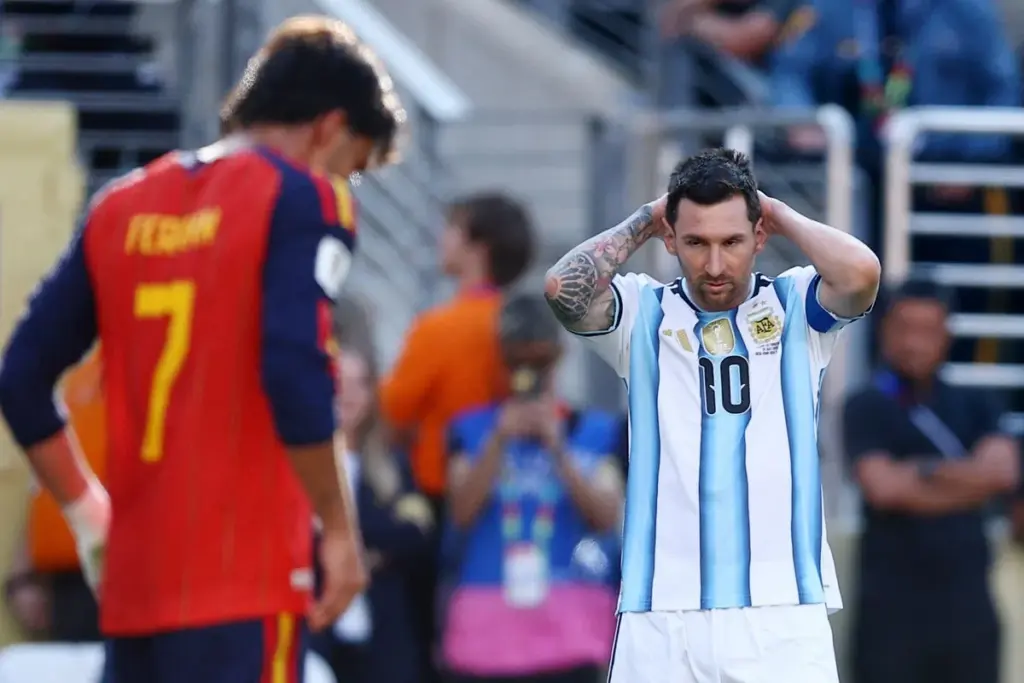
Spain has claimed its second World Cup title, defeating defending champions Argentina in a final match that saw Ferran Torres score the decisive goal in extra time. The victory marks a significant achievement for La Roja, while Argentina‘s campaign, and potentially Lionel Messi‘s final World Cup appearance, ended in defeat.
The match, held at the New York New Jersey Stadium, was characterized by contrasting styles. Spain, known for its patient, possession-based football, aimed to control the game through meticulous passing. In contrast, Argentina frequently resorted to fouls and gamesmanship, attempting to disrupt the flow of the match. This clash of approaches, described by some as “boring” versus “dirty,” contributed to a final that did not live up to the drama of previous stages of the tournament.
Match Dynamics and Delays
The final experienced several unusual delays. The kick-off was six minutes late following an unexpected speech. More significantly, there was a 27-minute delay between the end of the first half and the start of the second. Organizers had initially indicated a half-time show of around 20 minutes, but the extended delay exceeded the stipulated 15-minute half-time break outlined in the game’s laws. Former England captain Wayne Rooney criticized the half-time show, though Spain reportedly played some of its best football immediately after the extended break.
Further interruptions included a second hydration break, a common feature throughout the tournament, but one that can hinder a match’s rhythm. The playing surface itself also drew criticism. Concerns about the pitch at the New York New Jersey Stadium had been raised weeks prior, with Brazil star Vinicius Jr noting that the grass dried out quickly, slowing down play. On ITV, Ian Wright described the pitch as “ridiculous, poor, terrible,” and “bobbly and dry,” conditions not conducive to fluid attacking football.
The 3 PM ET kick-off time in New Jersey, corresponding to 8 PM BST, was likely scheduled to accommodate the European television market, alongside local and South American audiences. However, starting the game in the middle of the afternoon during the hottest part of the day, with temperatures reaching 27C / 80.6F, was not ideal for the players. The outdoor nature of the New York New Jersey Stadium meant it was exposed to the elements, unlike the semi-final venues in Atlanta and Dallas, which featured retractable roofs and air conditioning.
Argentina’s Fatigue and Post-Match Incidents
Argentina appeared particularly fatigued, having endured an emotionally and physically demanding tournament. Their journey included extra time matches against Cape Verde and Switzerland, as well as late victories against Egypt and England. This contrasted with Spain, who had won all four of their knockout matches in 90 minutes and had an extra day of rest before the final. Historical trends suggest that an extra day of rest is often crucial in major tournament finals, with 15 out of 20 men’s and women’s major tournament finals since Euro 2004 being won by the team with this advantage.
The fatigue factor for Argentina was highlighted by their increased fouling, which ultimately led to Enzo Fernandez receiving a red card shortly before extra time. Argentina failed to register a single shot before Ferran Torres put Spain ahead. The match concluded with further controversy as Leandro Paredes was sent off after the final whistle for an apparent altercation with Spain‘s Eric Garcia and Gavi, marking a disappointing end to Argentina‘s tournament.
The final’s referee, Slavco Vincic, is known for a high average of fouls awarded in the Champions League over the past five seasons, with a ratio of 23.6 fouls per game, the second highest among referees with more than 15 games officiated. This background suggested a game with a potentially high foul count from both sides, as Argentina‘s opponents in their last 25 competitive games averaged 14 fouls per 90 minutes, and Spain averaged 12.5 fouls per 90 minutes across their 14 major tournament games.
Read Also
Source: skysports.com

